

Precision-Engineered vs Enhanced Exhaust Parts: Which Lasts
Quick Summary
Precision-engineered parts guarantee fitment, while enhanced performance describes flow and turbo response, and durability depends mainly on alloy and welds. For exhaust components that survive repeated heat cycling, 347 stainless steel with niobium stabilisation offers better durability than aluminised mild steel or unstabilised 304 stainless. Fitment and proper torquing matter as much as the material.
- Precision-engineered means fitment, tolerance and repeatability; enhanced performance means flow and turbo response.
- Most exhaust failures start at flanges and welds rather than the middle of the tube.
- 347 stainless steel is niobium stabilised, preserving chromium for corrosion resistance under repeated heat cycles.
- Re-torque manifold and turbo fasteners after the first heat cycle, once the engine has fully cooled.
- Performance gains depend on the rest of the build, so a manifold alone will not transform a truck.
Table of Contents
- Precision-Engineered vs Enhanced Performance: What the Terms Mean
- Material Science and Durability: 347 Stainless Steel in Practice
- Power, Torque and Exhaust Flow: Where Performance Gains Come From
- Installing a 2nd Gen Cummins Turbo: Fitment Matters More Than Flow
- Exhaust Gas Temperature Management and Thermal Stress
- Cost-Benefit Analysis and Legal Compliance for Towing and Off-Road Builds
- Choosing Your Exhaust Components and Planning Your Next Build
- Frequently Asked Questions
Precision-Engineered vs Enhanced Performance: What the Terms Mean
Last Updated: November 12, 2026
Engineering Performance Concepts builds exhaust components for Cummins engines, and "precision-engineered" gets thrown around a lot.
Precision-engineered describes parts made to tight dimensional tolerances so that flanges, ports and mounting points line up without forcing. Enhanced engine performance describes what changes in the engine when exhaust gas leaves the cylinders more freely and the turbo spools more efficiently.
Buyers tend to mix these ideas together. A cheaper manifold may look similar on paper, yet differ in wall thickness, weld quality and flange finish, differences that rarely show in a photo but show up after a few thousand kilometres of towing.
Here is the practical split:
- Precision-engineered means fitment, tolerance and repeatability.
- Enhanced performance means flow, back pressure and turbo response.
- Durability depends on the alloy, the welds and how the part handles thermal stress.
Material Science and Durability: 347 Stainless Steel in Practice
Most exhaust failures start at the flanges and welds, not the middle of the tube. Manifolds see rapid temperature swings every time the engine starts, runs hard and cools, and that cycling causes fatigue cracks where the metal is thin or poorly supported. Alloy choice is the difference between a manifold that lasts a decade and one that cracks within a season of heavy towing.
Why alloy choice matters more than wall thickness alone
Three material families dominate the exhaust market, and they behave very differently under repeated heat cycling:
- Aluminised mild steel is cheap and easy to form, but its aluminium-silicon coating is sacrificial. Once breached by a weld, clamp or stone strike, the steel oxidises from the inside out. Fine for a factory replacement on an untuned vehicle, poor for a turbocharged diesel that runs hot under load.
- 304 stainless steel offers good general corrosion resistance and is widely used for cat-back systems. It is not stabilised, so prolonged exposure to the 600-900°C range typical of a turbo manifold can leave it vulnerable to sensitisation at the grain boundaries.
- 347 stainless steel is a stabilised austenitic grade. Niobium is added to the melt so carbon forms niobium carbides rather than chromium carbides at the grain boundaries, preserving the chromium that provides corrosion resistance. A 347 manifold therefore holds up better to repeated heat cycles than an unstabilised grade of similar thickness.
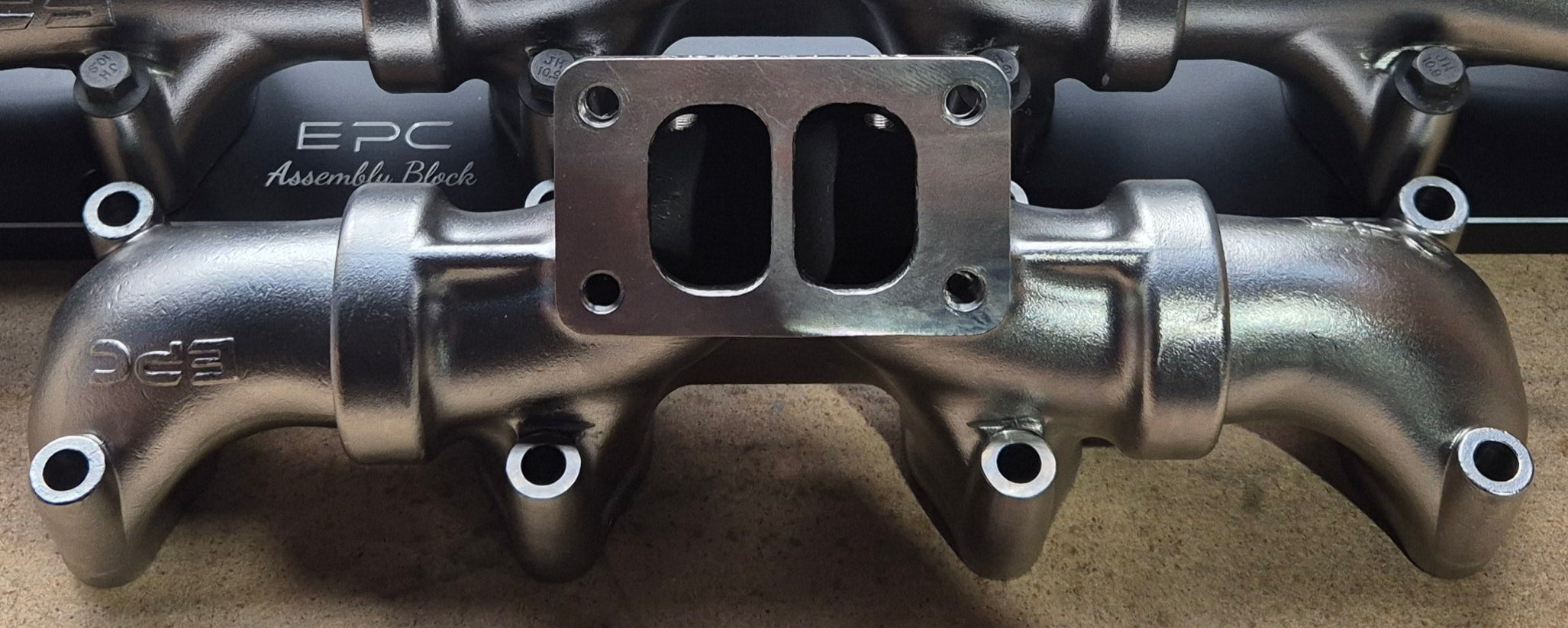
The EPC 8VT3TS40 and 12VT3TS40 T3 twin-scroll manifolds are manufactured from 347 stainless steel with niobium, which is designed to withstand high exhaust temperatures and repeated heat stress.
The failure modes that actually occur
A manifold rarely fails in the middle of a runner. The common failure points are:
- Flange distortion. Uneven torque or a warped flange face causes a leak that ticks under load and worsens as the gasket erodes.
- Weld toe cracking. Thermal fatigue concentrates in the heat-affected zone beside a weld. Poor fit-up, a bridged gap, or a weld too thin at the toe will crack first.
- Turbine inlet cracking. Where the manifold meets the turbo sees the highest and most rapid temperature swings, so a restrictive or poorly supported design shows stress there first.
- Fastener relaxation. Studs and nuts loosen as the manifold expands and contracts; a manifold tight at install can leak within a few heat cycles if not re-torqued.
Stainless does not make a part indestructible. Poor weld preparation, uneven clamping or a skipped gasket can cause leaks regardless of alloy. A few checks help:
- Torque manifold and turbo studs in the sequence the instructions specify, and re-check after the first heat cycle.
- Inspect welds and flange faces for hairline cracks after the first few hundred kilometres.
- Replace gaskets when the manifold is removed, rather than reusing them.
Watch out: installing a manifold without re-torquing after warm-up is a common cause of exhaust leaks that look like a part failure.
A long-term care protocol for precision-engineered parts
Most content on exhaust upgrades stops at the install. The parts that last are the ones that are maintained, and a simple protocol covers most of the risk:
- First 500 km: re-torque all manifold and turbo fasteners to specification once the engine has cooled completely, and check flange faces for soot tracking.
- Every service interval: inspect for cracks at the collector and turbine flange, check gasket condition, and confirm EGT probe fittings are tight.
- Annually, or before a heavy towing season: check for surface discolouration that has progressed to scaling, which suggests the alloy is being pushed beyond its design temperature, and review logged EGT data if probes are fitted.
- After any turbo or downpipe work: treat the manifold fasteners as disturbed and re-torque them, because the clamping load will have changed.
A stabilised alloy like 347 buys tolerance for heat cycling, not tolerance for neglect. The maintenance protocol converts a good material choice into long service life.
The article compares the three main exhaust alloy families and how each handles repeated heat cycling.
| Material | Heat-cycling behaviour | Key difference |
|---|---|---|
| Aluminised mild steel | Coating breached by welds, clamps or stone strikes | Sacrificial coating; oxidises from inside out |
| 304 stainless steel | Vulnerable to sensitisation at grain boundaries | Good corrosion resistance; not stabilised |
| 347 stainless steel | Better tolerance of repeated heat cycles | Niobium stabilised; preserves chromium |
Power, Torque and Exhaust Flow: Where Performance Gains Come From
Performance gains from an exhaust manifold come from reducing back pressure and improving how exhaust pulses reach the turbine.
Gains depend on the rest of the build: turbo size, injection, intake, tuning and the downpipe. A manifold alone will not transform a truck.
Our T3 twin-scroll manifolds include two 1/8" NPT ports, which allow EGT or exhaust pressure monitoring. Watching these readings is the most reliable way to confirm that the change in flow is doing what you expect.
Installing a 2nd Gen Cummins Turbo: Fitment Matters More Than Flow
Fitment is where most conversions succeed or fail.
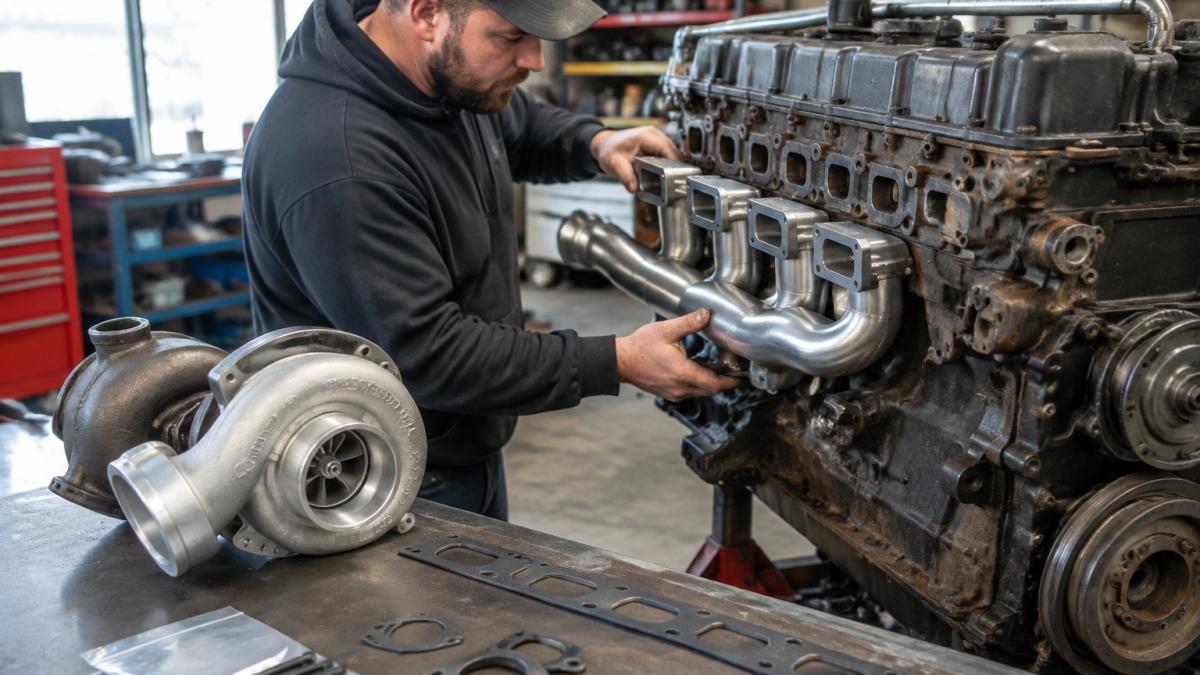
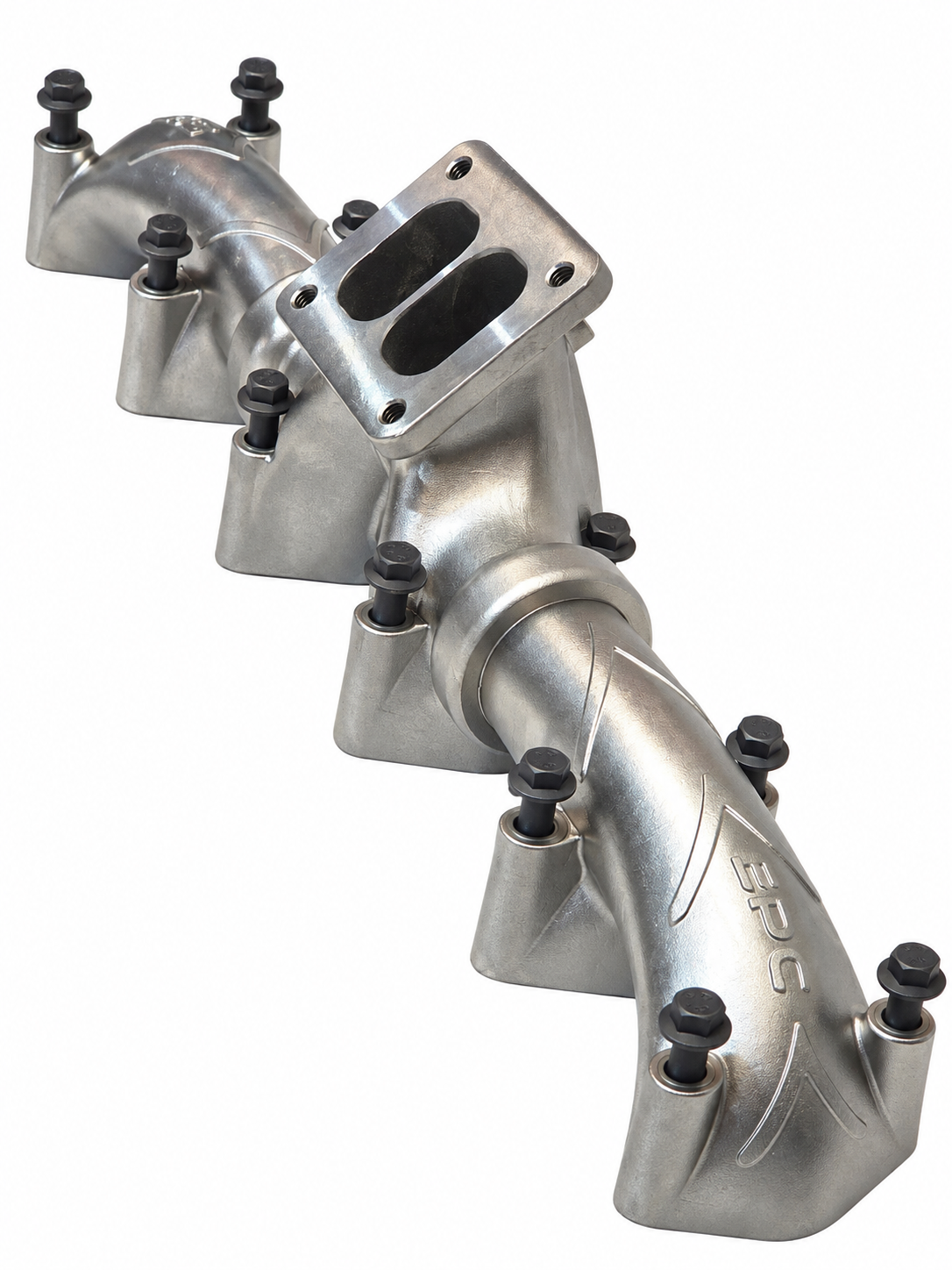
The 24VT4TS40 uses a 10mm extended turbo flange to improve clearance around the turbocharger. Before ordering, confirm your turbocharger flange pattern, downpipe and intake routing against the part listing rather than assuming they match.
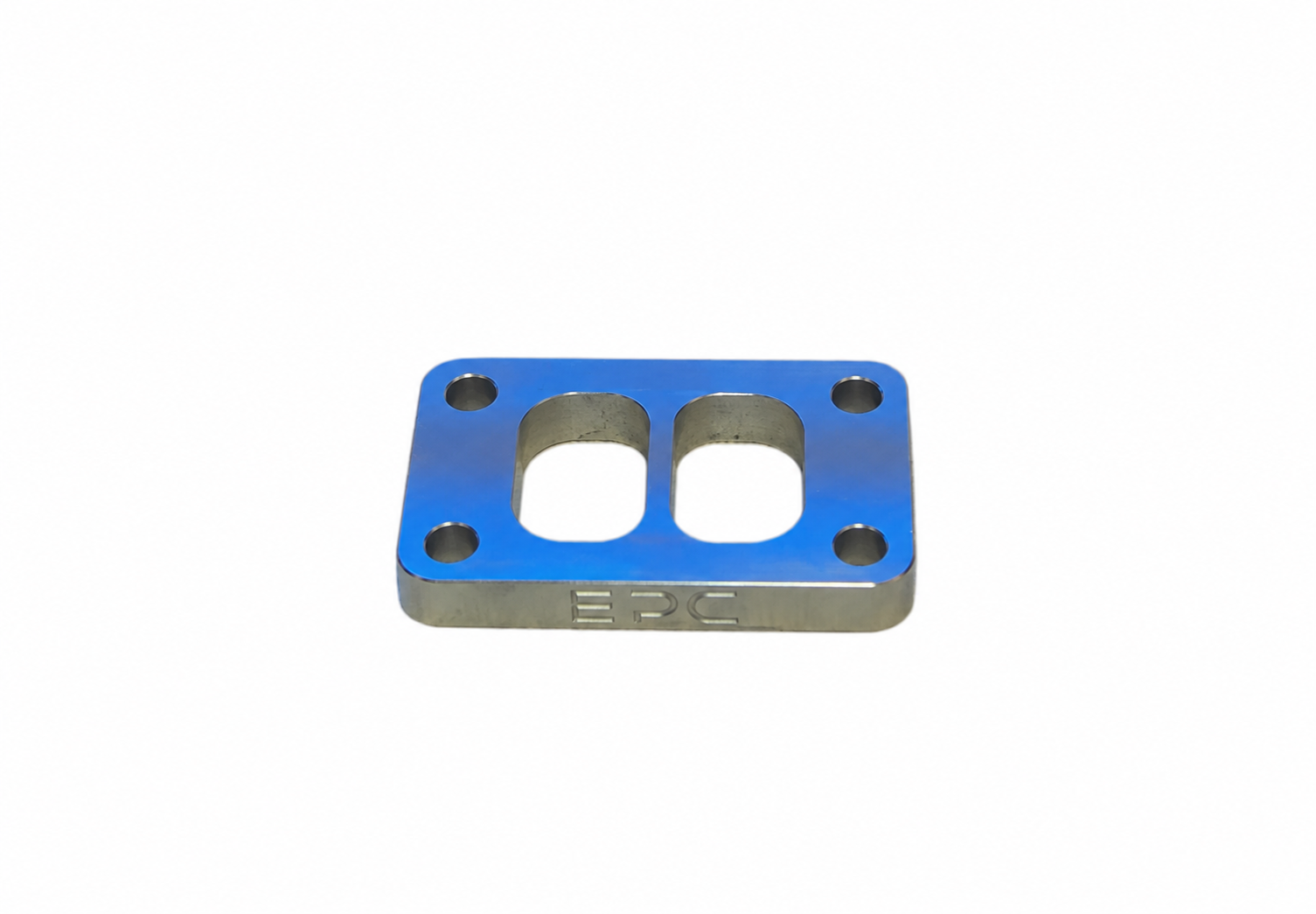
Our EPC T3 Turbo Exhaust Spacer is useful when you need extra standoff between a T3-pattern turbo and its exhaust connection. Test-fit the full assembly before final welding or tightening, because a spacer changes the position of everything downstream.
A typical installation sequence looks like this:
- Dry-fit the manifold and turbo without gaskets to check clearance.
- Confirm the downpipe and oil feed/drain lines will route cleanly.
- Install gaskets and torque studs in stages.
- Check for interference at full steering lock and suspension travel.
- Start the engine, let it warm, and re-torque.
Exhaust Gas Temperature Management and Thermal Stress
Exhaust gas temperature, or EGT, tells you how hard the engine is working and how much heat the exhaust system is absorbing.
The dual EGT probe ports on the 24VT4TS40 and the 1/8" NPT monitoring ports on the T3 designs allow EGT probes to be fitted at the manifold.
Thermal stress is the other half of the picture. Sudden cold starts and hard shutdowns after long pulls both cause expansion and contraction.
Cost-Benefit Analysis and Legal Compliance for Towing and Off-Road Builds
Cost comparisons should look at total ownership, not just the part price. A manifold that costs less up front but fails in three years, or forces a fabrication job at install, is rarely cheaper. Compare material grades and design choices over the life of the vehicle.
Comparing material grades on total cost
The table below frames the trade-off in general terms rather than quoting competitor prices. The pattern is consistent across the market: the cheaper the alloy, the shorter the expected service interval and the higher the risk of a secondary repair.
- Aluminised mild steel: lowest purchase price, shortest service life under turbo heat, highest likelihood of a repeat repair within the ownership period. The hidden cost is labour, removing a cracked manifold twice costs more than the part itself.
- 304 stainless steel: mid-range price, good corrosion resistance, but not stabilised. Suitable for naturally aspirated or lightly loaded applications; less suited to a tuned turbo diesel seeing sustained high EGT.
- 347 stainless steel: highest material cost, but stabilised chemistry and fitment precision reduce the risk of fatigue cracking and leak-driven rework. For a high-kilometre towing truck, cost per year of service is typically the lowest of the three.
Current pricing for the Cummins manifolds and components is:
- 24V Cummins T4 manifold (6.7 2nd Gen): $1,139.99 AUD
- 4BT T3 twin-scroll manifold: $649.00 AUD
- 2nd Gen 5.9L 12V T3 manifold: $929.99 AUD
- T3 Turbo Exhaust Spacer, 10mm: $49.99 AUD
- DIY 12-valve sheet metal manifold laser-cut file: $0.99 AUD
The DIY file is intended for fabricators with access to laser cutting and welding. Material and labour are real expenses to budget for.
Where the return actually comes from
A performance manifold is not justified by fuel savings alone. Value can come from several places:
- Reduced rework. A part that fits and holds torque the first time avoids the labour cost of a second removal and refit.
- Turbo life. Lower back pressure and better heat management can reduce thermal load on the turbocharger.
- Tuning headroom. Monitoring EGT allows a tuner to work within safe temperature limits.
Legal compliance for towing and off-road builds
Legal compliance matters for towing and off-road builds. Modifications to exhaust and emissions equipment can affect roadworthiness and may need to be checked against the rules that apply in your state or territory. Vehicle modifications may need to be checked against applicable national and state requirements, so check with your state road authority or a licensed certifier before you register a modified vehicle. Vehicle Standards Australia modification guidance
Three practical points are worth checking before you order:
- Emissions equipment. Removing or bypassing a catalytic converter or diesel particulate filter is a compliance issue in most jurisdictions and can affect registration. A manifold swap that retains the factory emissions hardware is a lower-risk path.
- Noise and exhaust configuration. A change in manifold or downpipe can alter noise output; confirm the resulting configuration still meets applicable noise limits for your vehicle category.
- Insurance disclosure. Notify your insurer about significant engine and exhaust modifications, as undisclosed changes can complicate a claim.
Fitment and compliance are separate questions, and only compliance affects registration and insurance.
Choosing Your Exhaust Components and Planning Your Next Build
Choosing between precision-engineered and performance-focused parts comes down to your build. A street truck used mainly for commuting benefits from good fitment and reliable materials.
Best for: owners of 6.7 Cummins and 2nd Gen turbo swaps who want a T4 solution with extended turbo flange clearance.
Skip if: your build has no turbo change and you only need a stock-style replacement.
If you are planning a broader build, start with fitment and thermal management, then add flow and tuning.
Frequently Asked Questions
How do precision-engineered exhaust components improve engine longevity?
Precision-engineered exhaust components can be manufactured from corrosion-resistant stainless steel, such as 347 stainless with niobium. Longevity still depends on correct installation, torque sequence and periodic checks for cracks and loose hardware.
What is the difference between performance-focused and durability-focused exhaust parts?
Performance-focused parts prioritise exhaust flow, scroll design and pulse separation to support power and turbo response. Durability-focused parts prioritise material grade, wall thickness and fabrication quality to resist cracking under heat. The strongest options combine both, such as a twin-scroll manifold in 347 stainless steel, so check the material and fitment specs alongside the flow claims.
Are precision-engineered parts worth the higher cost for towing applications?
The EPC 24VT4TS40 is listed at $1,139.99 AUD. Weigh the price against your turbo, downpipe and tuning costs, and confirm fitment before ordering. Light street use may not justify the premium.
Does a 2nd Gen Cummins turbo conversion require different exhaust manifolds?
The EPC 24VT4TS40 is designed for 6.7 Cummins 2nd Gen turbo swaps. The EPC 24VT4TS40 is built for 6.7 Cummins 2nd Gen turbo swaps with a T4 twin-scroll flange and 10mm extended flange position. Always verify turbocharger, downpipe and intake compatibility before purchase.
