

Cummins Engine Conversion Nissan Patrol Guide
Table of Contents
- Why a Cummins Engine Conversion Suits the Nissan Patrol
- Cummins 6BT Nissan Patrol Conversion: Power, Torque and Fitment
- Cummins 4.5 Nissan Patrol Conversion: The Lighter Four-Cylinder Option
- Cummins to Nissan Patrol Gearbox Adapter Options
- Step-by-Step Cummins Engine Conversion Procedure
- Cooling, Wiring, Exhaust and Fuel System Integration
- Nissan Patrol Engine Swap Engineering Approval and Compliance
- Costs, Reliability and Long-Term Ownership
- Frequently Asked Questions
Last Updated: October 8, 2026
Why a Cummins Engine Conversion Suits the Nissan Patrol
A Cummins engine conversion for a Nissan Patrol replaces the factory engine with a Cummins diesel, trading peaky power for low-rpm torque that suits towing and off-road work.
The Patrol is heavy with a strong driveline, a good home for a torque-rich diesel. What changes:
- Torque arrives low in the rev range, so you climb hills without constant gear changes
- The engine bay gets tighter, so sump and mount choices matter more
What Changes When You Swap the Engine
Everything downstream of the flywheel needs a decision. Engine mounts, sump depth, gearbox adapter, cross member and tailshaft all shift once the new block goes in. Get those wrong and the build stalls for weeks.

Cummins 6BT Nissan Patrol Conversion: Power, Torque and Fitment
The 6BT 5.9L delivers big torque from low revs: roughly 160 to 215 horsepower in common factory tunes, with far more available once you change the fuel and turbo setup.
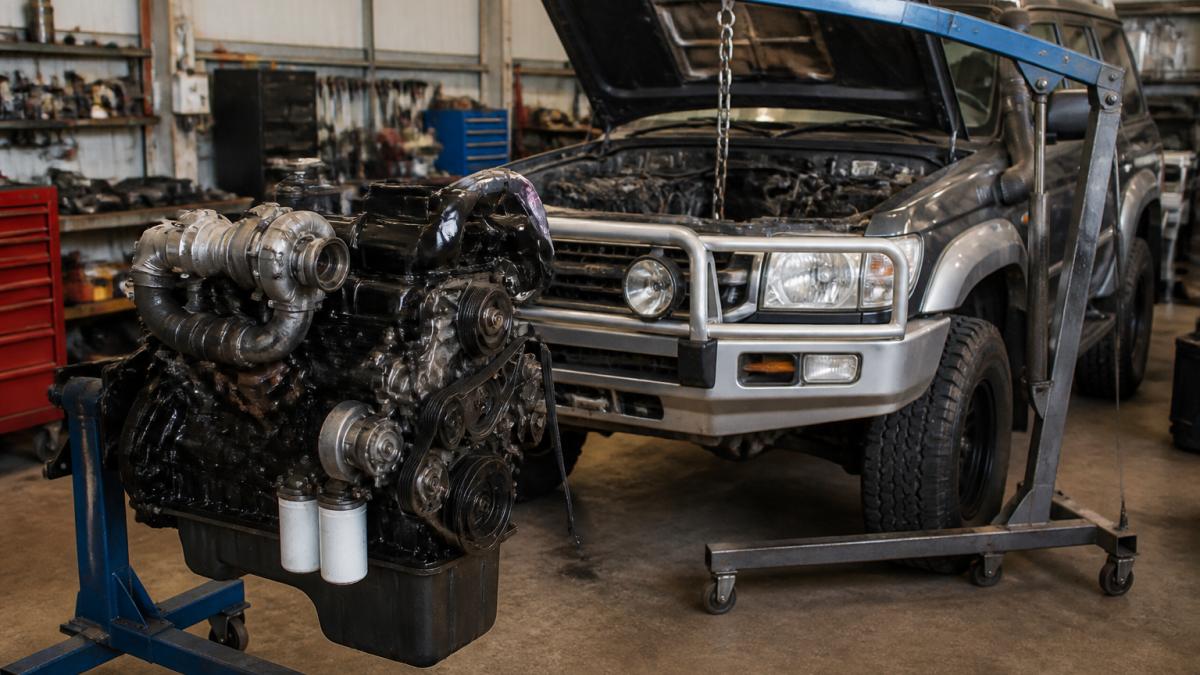
Torque is the headline. Fitment is where the work lives, the 6BT is long and tall, crowding the firewall and front cross member.

Sump Clearance and Engine Mount Requirements
Sump clearance decides whether the swap fits at all. The 6BT rear-sump pan often fouls the Patrol front diff and steering, so many builds use a modified or extended sump pickup to keep oil flow safe.
Engine mounts are just as strict: they must hold the block at the right height and angle and survive years of vibration.
Our extended oil suction tube for the 6BT solves the pickup reach problem on GU and GQ models with a rear sump.
Cummins 4.5 Nissan Patrol Conversion: The Lighter Four-Cylinder Option
A Cummins 4.5 Nissan Patrol conversion suits owners who want diesel torque without the weight and bulk of a straight-six. The four-cylinder 4.5L frees engine bay space and puts less load on the front end.
- Lighter than a 6BT, so steering and suspension feel closer to stock
- More room around the block for cooling and exhaust routing
Cummins to Nissan Patrol Gearbox Adapter Options
The Cummins to Nissan Patrol gearbox adapter decides whether your factory manual survives the swap.
Our GQ and GU Cummins adapter plate and flywheel kit mates a 6BT to the factory Patrol five-speed manual. The kit includes a CNC-machined 6061 aluminium adapter plate and a Cummins-to-Patrol flywheel.
Clutches are not in the kit; source one through a clutch specialist to suit your torque figure.
| Option | Keeps Factory Box? | Best For | Watch Out For |
|---|---|---|---|
| Adapter plate + flywheel | Yes | Most 6BT manual builds | Clutch must match torque |
| Full gearbox swap | No | High-torque competition | Cost and fabrication time |
| Automatic conversion | No | Towing and daily driving | Wiring and cooling work |
Transfer Case and Driveline Matching
The transfer case and driveline must line up once the engine and gearbox sit in their new position.
An adjustable cross member helps here. Our adjustable GU Patrol cross member gives 80mm of forward and backward adjustment in 5mm steps, so you can dial in transfer case position without cutting and re-welding.
Get the driveline angles right and you avoid vibration and premature uni-joint wear.
Step-by-Step Cummins Engine Conversion Procedure
Here is a sequenced procedure with decision gates: the order that works and what to confirm before you move on.
Stage 1: Planning and Measurement (Before You Buy Anything)
- Define the goal: daily towing, touring, or competition. This sets your engine choice, clutch rating, cooling capacity and gearbox strategy.
- Measure the engine bay: firewall-to-radiator clearance, chassis rail width, and cross member-to-bonnet height. Photograph and note every measurement.
- Measure sump clearance against the front diff and steering drag link at full suspension compression, not ride height. Static clearance is meaningless if the diff rises into the sump under articulation.
- Confirm your state or territory's modified vehicle requirements before committing. Some jurisdictions require the engineer to see the vehicle at specific build stages.
- Set a realistic budget and timeline. A first-time conversion commonly runs several months of weekends; a workshop build is faster but adds labour cost.
Decision gate: if sump clearance cannot be solved with a modified pan and pickup, stop and reconsider the engine or the vehicle.
Stage 2: Engine Selection and Preparation
- Choose between the 6BT 5.9L straight-six and the 4.5L four-cylinder based on your Stage 1 goal and clearance measurements.
- If buying used, inspect before it goes near the vehicle: compression test, blow-by check, injection pump inspection, and confirm the turbo has no excessive shaft play.
- Decide the tune now. Fuel pump settings and turbo choice determine clutch rating, cooling load and exhaust sizing, changing the tune later forces rework across all three.
- Replace the rear main seal, front crank seal and accessible gaskets while the engine is on the stand. Cheap now, painful once installed.
Stage 3: Bench Assembly
- Bolt the adapter plate and flywheel to the engine on the bench, following the manufacturer's torque sequence.
- Mate the gearbox to the engine on the bench. Confirm input shaft engagement, bellhousing alignment and clutch release travel before the assembly goes near the vehicle.
- Fit the engine mounts to the block on the bench, far easier than threading bolts into a block hanging from a crane.
Stage 4: Installation and Positioning
- Lower the assembly into the bay with a leveller, watching the firewall, steering shaft and brake booster.
- Set engine height and angle so the output shaft aligns with the diff pinion and driveline angles stay within limits.
- Position the transfer case and cross member, using an adjustable cross member so you can dial in position without cutting and re-welding.
- Tack the mounts and cross member, re-check clearances, then finish the welds. Never fully weld before confirming the assembly sits correctly.
- Measure for the tailshaft, any change in engine or gearbox position changes the required length and angle.
Stage 5: Supporting Systems
- Build the cooling system: radiator, fan, shroud and hoses. Size the radiator for the new heat load, not the old engine.
- Route the exhaust from the turbo back, keeping clearance from fuel lines, brake lines and wiring.
- Wire the starter, alternator, gauges, glow system (if fitted) and shut-off. Label every circuit as you go.
- Set up the fuel supply: lift pump, filters, lines and return. A mechanical injection pump needs clean, unrestricted flow.
- Connect power steering, throttle linkage and any vacuum or boost reference lines.
Stage 6: Commissioning and Testing
- Prime the fuel system and check for leaks before cranking.
- Crank with the fuel shut off to build oil pressure, then start.
- Check for leaks, unusual noises and correct gauge readings at idle.
- Bring the engine to operating temperature and confirm the cooling fan and thermostat cycle correctly.
- Road test in stages: low-speed manoeuvring, then light load, then highway and towing. Log any vibration, overheating or drivability issue.
- Re-torque mounts, check fluid levels and inspect for chafe after the first 100 km, then again at 1,000 km.
- Book the engineering inspection once the build is complete and any issues are resolved.
Realistic Timeframes
- Planning and parts sourcing: weeks to months, depending on availability
- Engine preparation: a weekend to several weeks if a rebuild is needed
- Installation and fabrication: several weekends for a home build
Cooling, Wiring, Exhaust and Fuel System Integration
Cooling, wiring, exhaust and fuel decide whether the swap runs reliably or fights you forever.
Nissan Patrol GQ/GU Cummins Adapter Plate – 6BT Manual Conversion. GROUP BUY →

Cooling first. A Cummins makes more heat than the factory engine, so the radiator, fan and shroud must match the new load.
Wiring next. A mechanical Cummins needs very little, but you still have to sort the starter, alternator, gauges and shut-off.
Exhaust routing depends on your turbo and manifold choice.
Fuel delivery rounds it out.
Nissan Patrol Engine Swap Engineering Approval and Compliance
A Nissan Patrol engine swap engineering approval is a legal step, not optional. In most states, a modified vehicle needs a signatory engineer to inspect the change and issue a report before you can register it.
Rules differ between states and territories, so check your local transport authority before you start. The engineer will look at:
- Engine mounts and their strength
- Brake and steering clearance
- Emissions and engine age
Insurance is the other half. Tell your insurer about the conversion and get it listed on the policy. An undisclosed engine swap can void a claim when you need it most.
Costs, Reliability and Long-Term Ownership
A Cummins engine conversion is a serious spend, and the total is rarely the engine price.
Itemised Budget Breakdown
Costs vary with engine condition, how much fabrication you do yourself, and how far you go on performance parts.
| Item | What Drives the Cost | Notes |
|---|---|---|
| Engine | Condition, mileage, whether a rebuild is needed | A rebuild can exceed the purchase price |
| Adapter plate and flywheel | Whether you buy a kit or have one machined | A kit saves weeks of fabrication |
| Clutch | Torque rating | Must match your final tune, not your initial plan |
| Engine mounts and cross member | Custom vs adjustable off-the-shelf | Adjustable saves rework |
| Sump and oil pickup | Modified or extended | Often overlooked until clearance fails |
| Cooling system | Radiator, fan, shroud, hoses | Undersizing here causes repeat failures |
| Exhaust | Manifold, turbo, dump pipe, full system | Turbo choice affects everything downstream |
| Fuel system | Lift pump, filters, lines, return | Mechanical pump needs clean, high-flow supply |
| Wiring and gauges | Complexity of the loom | Mechanical engines need less, but not none |
| Tailshaft | Length and balance changes | Any driveline shift requires measurement |
| Engineering approval | Jurisdiction and complexity | Varies significantly by state and territory |
| Labour | Your own time vs a workshop | The largest variable in the whole build |
The honest summary: the engine is often the smallest line item once fabrication, cooling, exhaust, driveline and compliance are accounted for. Budget a contingency of at least a quarter of your parts total, almost every build uncovers something unexpected.
What Drives the Variance
- Engine condition. A low-kilometre donor with service history costs more upfront but avoids a rebuild.
- DIY vs workshop. Doing the fabrication yourself saves labour but adds months and requires welding, machining and wiring skills.
- Performance ambition. A mild tune needs less clutch, cooling and fuel system work than a high-output build.
Reliability: What Actually Fails
A correctly mounted Cummins with good cooling, clean fuel and a matched clutch runs for a very long time. Most failures trace back to a build shortcut:
- Oil starvation on angles. A stock sump with an unmodified pickup can uncover under articulation or steep descents, the single most damaging failure mode, and it destroys bearings.
- Cooling shortfall. An undersized radiator or unshrouded fan holds up in traffic but fails on long climbs or under load. Heat soak then affects everything from the head gasket to the wiring.
- Mount fatigue. Weak mounts crack, sag or shear. Once the engine shifts, driveline angles change and uni-joints and seals wear prematurely.
Maintenance and Service Intervals
A converted Cummins is not maintenance-free:
- Oil and filter changes at the interval recommended for your engine and use case, shorter if you tow or run dusty conditions
- Fuel filter changes at least as often as specified, more frequently if fuel quality is variable
- Coolant checks and periodic flush, especially after the first few heat cycles of a new build
Parts Availability and Long-Term Ownership
The 6BT and 4.5L families are widely supported, and consumables, filters, gaskets, belts, water pumps, are easy to source through diesel specialists and aftermarket suppliers.
Conversion-specific parts are the exception. Adapter plates, mounts, cross members and modified sumps come from a smaller pool of suppliers, so keeping records of what was fitted and where it came from saves pain later, and supports resale value if you sell.
Resale and Insurance Considerations
- Insurers may require the conversion to be listed on the policy, and some will not cover modified vehicles at all. Confirm before you buy.
- Keep receipts, the engineering report and any compliance paperwork together. Buyers and insurers both ask for them.
Frequently Asked Questions
Which Cummins engines can be fitted to a Nissan Patrol?
The most common choices are the 6BT 5.9L six-cylinder and the 4.5L four-cylinder (ISDE4.5). The 6BT delivers strong torque for towing and heavy off-road use, while the 4.5L weighs less and leaves more room in the engine bay. Both suit GQ and GU platforms, but each needs its own engine mount kit, sump arrangement and adapter solution. Confirm your intended gearbox and transfer case before ordering parts.
Can the original Nissan Patrol gearbox be used with a Cummins engine?
Yes, in many builds the factory Patrol five-speed manual is retained. A Cummins to Nissan Patrol gearbox adapter plate and matching flywheel mate the 6BT to the standard transmission. Clutches are usually sourced separately to suit your torque figure and driving style. If you plan big torque increases or heavy towing, check the gearbox condition first, because a worn unit will not last behind a Cummins.
What engineering approval is needed for a Cummins engine conversion?
An engine swap changes the vehicle's mass, power and emissions profile, so it typically requires engineering approval and a modification plate before registration can be updated. Requirements vary by state and territory, and you will usually need to show brake, steering and emissions compliance. Speak to a qualified automotive engineer before you buy parts, because approval conditions can affect your choices on mounts, exhaust and emissions equipment.
How much does a Cummins engine conversion cost?
Budget for the engine itself, adapter plate and flywheel, engine mounts, sump and oil pickup changes, cooling, exhaust, wiring, fuel system work, and engineering approval. Adapter kits start around $1,299, throttle cables around $290, and adjustable cross members around $850. Labour and fabrication often exceed the parts total, especially on a first-time build. Get quotes for the compliance side early so nothing surprises you late in the project.
Building a Cummins-powered Patrol is a big project, and the parts you choose early decide how smoothly it goes. At Engineering Performance Concepts, we make precision-engineered conversion hardware for exactly this platform, including the GQ and GU adapter plate and flywheel kit, the extended oil suction tube, the adjustable GU cross member and the Wild Customs throttle cable. Get started with Engineering Performance Concepts and build a Patrol conversion that fits right the first time.