

How to Choose a High Performance Turbo for a 6BT?
Quick Summary
The best 6BT turbo is one sized to your real horsepower target and working RPM band, not the biggest unit available. Start by setting target power, then match compressor flow and pressure ratio to the engine's airflow on a compressor map. Towing, street and competition builds each call for a different turbo.
- Set your peak horsepower and working RPM target before choosing any turbo.
- Calculate required airflow for a 350 hp 6BT at 2,800 RPM, roughly 940 CFM.
- Keep the operating line inside the compressor's efficient zone across your whole RPM range.
- Keep peak-power points at least 10-15% clear of the surge line.
- Upgrade fuel delivery, intercooling and exhaust alongside the turbo to avoid damage.
Table of Contents
- Setting a Horsepower Target for Your 6BT Turbo
- 6BT Turbo Sizing: Matching Capacity to Displacement and Airflow
- Reading a Turbocharger Compressor Map for 6BT Applications
- Choosing the Best Turbo for 6BT Towing Versus Street and Competition Builds
- Turbine Housing, A/R Selection and Spool-Up Trade-Offs
- Fuel System, Intercooling and Exhaust Upgrades That Support Your New Turbo
- Booking Your Turbo Build: Installation, Tuning and Validation Checks
- Frequently Asked Questions
Setting a Horsepower Target for Your 6BT Turbo
The answer to how to choose a high performance turbocharger for 6BT engines begins with one question: what horsepower and torque do you actually need? A turbo sized for 400 horsepower will feel sluggish on a truck that only needs 300.
Start with the use case. A daily-driven street truck, a towing rig and a drag or competition build each demand a different power band. A towing setup needs strong low-end torque to pull loads from a standstill. A competition build needs top-end airflow.
Keep a few practical checks in mind:
- Your current injection and fuel delivery set a ceiling. A turbo that pushes more air than the fuel system can match wastes money.
- Cylinder pressure and rod-bending load rise with boost. A high horsepower target may need upgraded internals before the turbo goes on.
- Power-to-weight matters for towing and racing. Extra horsepower adds little if the truck is already carrying heavy loads.
Watch out: chasing peak horsepower on a stock bottom end is the fastest route to a broken connecting rod. Set the target first, then confirm the engine can hold it.
6BT Turbo Sizing: Matching Capacity to Displacement and Airflow
Matching turbo capacity to engine displacement is the core of sizing. The 6BT's 5.9-litre displacement moves a fixed volume of air per revolution, so the turbo must supply enough pressure ratio to fill that volume at your target RPM without running too far off its efficiency island.
An undersized turbo spools quickly but runs out of breath near the top of the power band, creating heat and restriction. An oversized turbo flows well at high RPM but builds boost slowly, leaving the truck flat below 2,000 RPM.
Work through the sizing in this order:
- Calculate the airflow your target power needs, using displacement, peak RPM and a volumetric efficiency estimate.
- Compare that airflow against the compressor's flow range on its map.
- Check the required boost pressure against the compressor's pressure ratio at that flow.
- Confirm the turbine side can handle the exhaust energy your fuelling produces.
These steps keep the sizing grounded in numbers rather than guesswork, and they feed directly into the compressor map reading covered next.
Reading a Turbocharger Compressor Map for 6BT Applications
A compressor map plots pressure ratio against airflow, with efficiency islands showing where the unit works best. Learning to read it is the most useful skill in turbo selection, and it is where many 6BT builders go wrong. The way to make it concrete is to work a 6BT example end to end rather than reading maps in the abstract.
Worked 6BT example: 350 hp at 2,800 RPM
Take a 5.9-litre 6BT targeting 350 hp at 2,800 RPM. Most practitioners use a brake-specific fuel consumption figure of roughly 0.32-0.35 kg/kWh for a mechanical Cummins at this power level, and an air-fuel ratio near 22:1 at full load to keep exhaust gas temperature in check. From those inputs you can estimate the mass airflow the compressor must supply.
- Convert target power to fuel mass flow. At 350 hp (about 261 kW) and 0.33 kg/kWh, fuel flow is roughly 86 kg/h.
- Multiply by the target air-fuel ratio. At 22:1, required air mass flow is about 1,890 kg/h, or roughly 31.5 kg/min.
- Convert to volumetric flow at the compressor inlet. Using an inlet air density near 1.18 kg/m³ at 25 °C and sea-level pressure, that is about 26.7 m³/min, or roughly 940 CFM.
- Calculate pressure ratio. If you want about 20 psi of boost at sea level, pressure ratio is (14.7 + 20) / 14.7 ≈ 2.36, before allowing for intercooler and filter losses.
Those four numbers, roughly 940 CFM, a pressure ratio near 2.4, and a target of 350 hp at 2,800 RPM, are what you plot on a candidate compressor map. The point should sit inside the central efficiency island, ideally toward the right side where the unit still holds efficiency at higher flow. A point near the surge line on the left means the compressor is working too hard and will be unstable.
Plot the operating line, not just one point
A single point only tells you the engine at peak power. The real test is the operating line across the RPM range. Plot the same calculation at 1,400, 1,800, 2,200 and 2,800 RPM, using a realistic volumetric efficiency curve, volumetric efficiency typically falls away at the top end of the RPM range.
Two points help when comparing candidates:
- Compare maps at the same airflow scale. Maps from different manufacturers can be drawn with different axes, and a unit that looks comfortable on one map can sit near surge on another.
- Leave margin. Real engines run hotter and flow less than calculated, so allow room on both the surge and choke sides, a common pattern is to keep the peak-power point at least 10-15% clear of the surge line.
Watch out: a compressor map only shows the compressor. It says nothing about turbine restriction, so a well-matched compressor can still build back-pressure on a poor turbine side, and the map will not warn you.
Choosing the Best Turbo for 6BT Towing Versus Street and Competition Builds
The right turbo depends on how the truck is used, and the three main builds pull in different directions. A use-case matrix makes the trade-offs explicit, but the matrix only helps if it is tied to 6BT-specific numbers rather than generic advice.
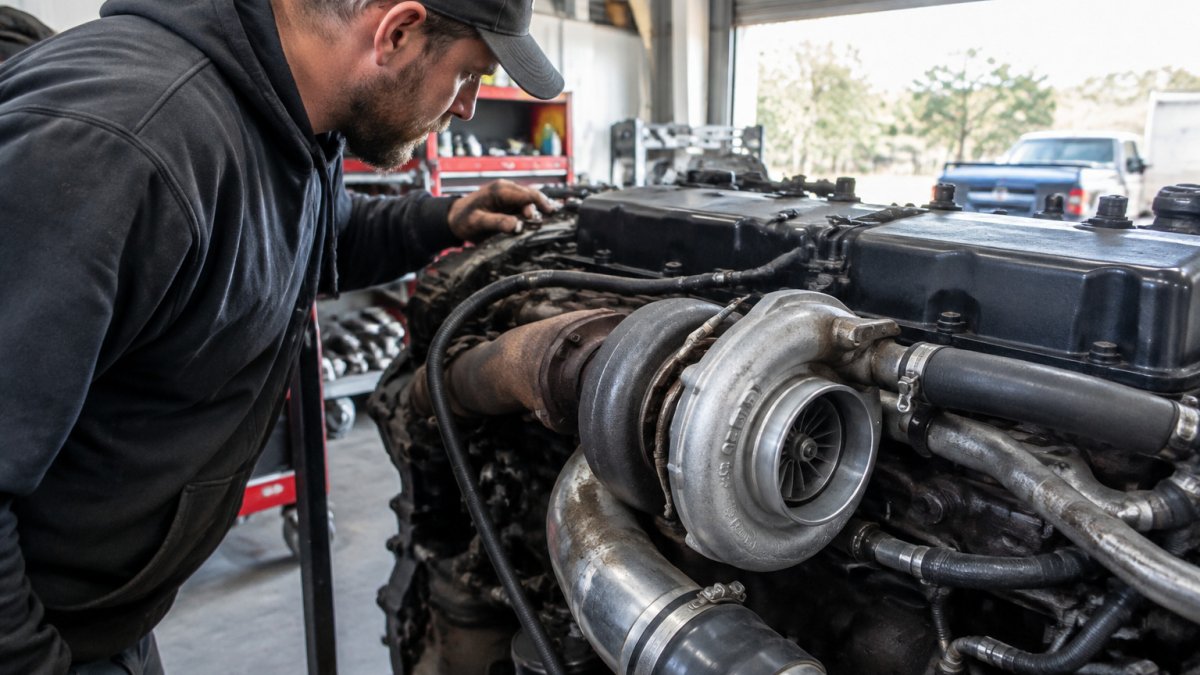
Towing and work-truck builds
Towing favours a unit that spools early and holds torque at mid-range RPM. Durability matters more than peak power on a towing build, so choose a unit with conservative boost targets and watch exhaust gas temperature closely on long climbs. A slightly smaller compressor and a tighter turbine housing A/R generally give quicker boost when pulling away from a standstill.
Street builds
Street builds balance response and everyday drivability. A moderately sized turbo keeps the truck pleasant in traffic and still delivers a noticeable gain over stock. The target is usually a broad torque curve rather than a single peak number. Most owners do not need the extra top-end flow of a race unit, and a mid-size compressor with a mid-range A/R is the common compromise.
Competition builds
Competition builds prioritise peak power and can accept slower response. A larger compressor and turbine flow more air at high RPM, but expect lag below the power band. The compressor map should stay efficient at the top end of the RPM range rather than in the mid-range. Boost targets rise, which is why supporting upgrades become part of the build rather than optional extras.
Use-case matrix
| Build | Working RPM band | Priority | Turbo character | Typical boost target | Main trade-off |
|---|---|---|---|---|---|
| Towing / work truck | 1,600-2,400 | Low-end torque, durability | Early spool, moderate flow, tighter A/R | 18-24 psi sustained | Less peak power |
| Street | 1,800-2,600 | Response and drivability | Balanced sizing, mid-range A/R | 20-28 psi | Modest top-end gain |
| Competition | 2,600-3,400 | Peak horsepower | Larger flow, looser A/R, late spool | 30 psi and above with supporting mods | Lag below power band |
Working RPM band
The correct boost level depends on fuelling, intercooling, compression ratio and the condition of the bottom end, which is why the horsepower target and the fuel system check earlier in this guide matter as much as the turbo itself.
Best for: towing and daily drivers who want strong mid-range pull. Skip if: you mainly want maximum peak horsepower at high RPM, where a larger unit suits better.
Watch out: choosing a competition-sized turbo for a truck that spends most of its life towing will feel worse than stock below 2,000 RPM, and the extra lag is not something a tune can fully fix.
Turbine Housing, A/R Selection and Spool-Up Trade-Offs
The turbine housing's A/R (area-to-radius) ratio controls how the exhaust gas accelerates into the turbine wheel. A smaller A/R spools faster and builds boost early, but restricts exhaust flow at high RPM and raises exhaust back-pressure.
This is the central spool-up trade-off. A small A/R suits towing and street use, where early boost matters. A larger A/R suits competition builds, where peak flow matters more than response. Some builders choose a middle A/R to balance both.
Watch the exhaust side closely. Back-pressure from a restrictive turbine housing raises cylinder temperatures and can offset the gains from extra boost. Match the housing to the exhaust energy your fuelling produces, not just to the compressor you chose.
Fuel System, Intercooling and Exhaust Upgrades That Support Your New Turbo
A new turbo raises air and heat loads throughout the engine. The fuel system, intercooling and exhaust must keep pace, or the upgrade will underperform or cause damage.
Fuelling is the first priority. More air needs more fuel, and an injection system delivering too little leaves the engine lean and hot.
Intercooling cools the compressed air before it enters the engine. Cooler charge air is denser and reduces detonation risk, which protects a high-output build. A properly sized intercooler matters more as boost rises.
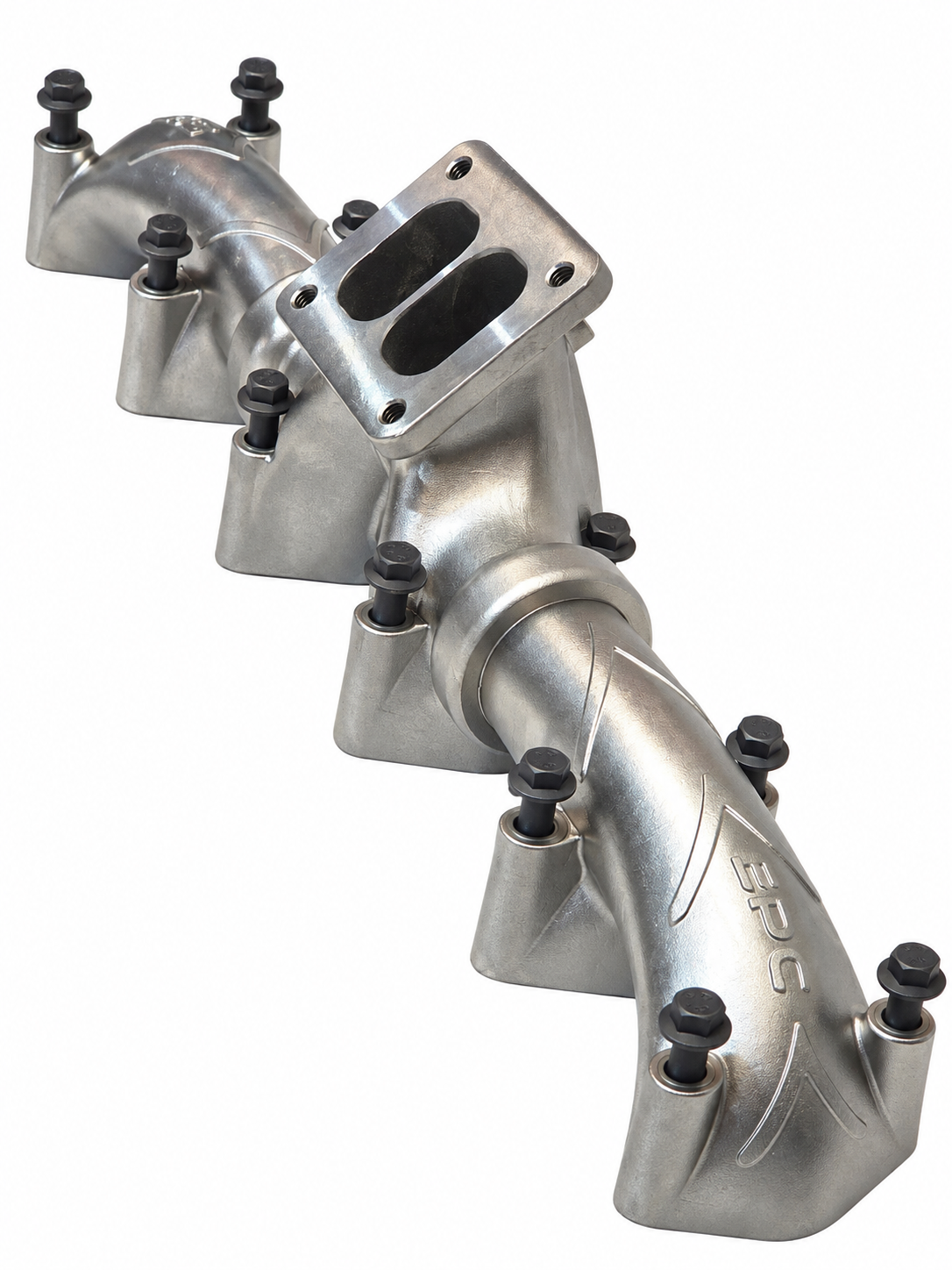
The exhaust side needs matching hardware. EPC's T4 twin-scroll manifold, the 24VT4TS40, is built for 6.7 Cummins 2nd Gen turbo conversions, providing a T4 mounting platform in 347 stainless steel with dual EGT probe ports for monitoring.
A compound setup can also suit a 6BT.
Booking Your Turbo Build: Installation, Tuning and Validation Checks
Once the turbo is selected, the build needs a careful installation and validation process. Rushing this stage is where many otherwise good setups fail.
Before you start, confirm the turbo's flange, oil and coolant lines, and mounting points against the engine and manifold. Fabrication fit is the most common delay.
After installation, validate the build in stages:
- Check for boost leaks at every coupling and clamp before full-load runs.
- Monitor exhaust gas temperature with the probe ports during initial pulls.
- Confirm oil supply to the turbo bearings and watch for any leaks.
- Retune fuelling and timing, then log boost and EGT under load.
Plan regular inspections after the first few hundred kilometres, and check for shaft play, leaks and heat stress.
Engineering Performance Concepts designs and manufactures Cummins performance parts, from T4 manifolds to turbo upgrade components. Our team can help you set your target and confirm the fitment for your build.
Frequently Asked Questions
How do I choose the right turbocharger for a 6BT Cummins?
Start with your target horsepower and how the truck will be used. A street or light-duty build benefits from a smaller turbo that spools quickly, while towing or sustained load needs more airflow at higher RPM. Check the compressor map against your expected airflow and confirm the turbine housing and A/R suit your exhaust. Pair the choice with fuel system and intercooling upgrades so the turbo can deliver its rated boost safely.
What size turbo is best for a 6BT Cummins?
There is no single best size. The right turbo depends on your power goal, duty cycle and the airflow your engine needs at its operating RPM. Smaller turbos build boost earlier and suit street or light towing, while larger units support higher peak power but can lag at low speed. Use compressor map data and your target airflow to narrow the choice, and avoid oversizing if low-RPM response matters to you.
What turbo is best for towing with a 6BT?
For towing, prioritise low-RPM response and steady boost under load over peak horsepower. A turbo sized for the engine's mid-range airflow suits towing better than a large unit that only comes on boost at high RPM. A compound setup can be considered, and the EPC HE300WG is listed for use as a smaller primary turbo in a compound arrangement. Confirm cooling, fuelling and exhaust temperatures can handle sustained towing loads before finalising your build.
Do I need to upgrade the fuel system when fitting a larger 6BT turbo?
In most cases, yes. A larger turbo moves more air, so the engine needs enough fuel to match. Without fuel system upgrades, boost increases can lead to a lean, hot condition and higher exhaust gas temperatures. Review injector and pump capacity, check your intercooling and confirm exhaust compatibility with the turbine housing before you increase boost.
